



Blood River has taught me that bringing characters from my imagination to the page isn’t always easy. Writing courses spend a lot of time on character description but very little on character visualisation.
Characters develop as their stories and the world they live in emerge through your writing. There comes a time when you need to drop an anchor, lest you forget whether someone had blue eyes, exactly how they wear their hair or the details of an outfit.
Visualising characters also helps me to consider their stories from a different perspective, and to think about how they change. Creating a visual representation helped me to challenge stereotypes and assumptions that I might never have noticed.
Unfortunately, I have no visual artistic ability. Words is ma thing.

Real and unreal humans
There are many approaches to character visualisation. A lot writers play the celebrity casting game, but I’m uneasy populating my stories with A-list inserts and flavour-of-the-month actors. At the other end of the originality scale, the freakish AI portrait generator This Person Does Not Exist will deliver infinite varieties of AI-generated humans. Generated Photos lets you fine tune the process, for a price. If you want endless cars, cats, MPs, horses and um, feet, try This X Does Not Exist for a journey down the rabbit hole of machine creativity.
None of these really scratched my character visualisation itch, although the AI face-generators can be inspiring. Ideally, I’d have a desktop version of the character creators you use at the start of games like Fallout. The closest I’ve come is Reallusion’s Character Creator 4. It will give you photo-realistic 3D models, but it’s designed for the gaming and FX industry so it’s hugely overpowered. At $199 for the basic package, it’s outside my budget. Alas, there’s also no Mac edition.
Epic Games’s Unreal Engine is one of the world’s leading 3D creation suites. and they’ve now added Metahuman Creator to a range of free tools. It’s an incredibly powerful package for making photorealistic animated 3D avatars and it works in the browser.
It’s still in development and there are limits. Design sessions are limited to an hour and the clothing options are very limited and other than a screenshot. You also need Unreal Engine or Maya Autodesk to make use of your creations, which demands powerful hardware.
You don’t have to spend a lot of money on character visualisation, which will be a relief to most writers.
MakeHuman is a powerful and free community-driven alternative. It’s also more than I need and the learning curve is vertiginous. Charactercreator.org is another community project that creates 2D illustrations. It’s fun but there’s limited depth to the customisation you can add.
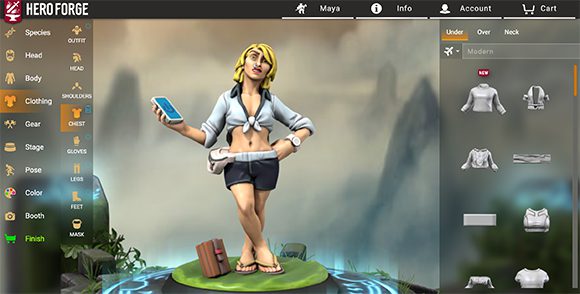
Heroforge to the rescue
Then I found HeroForge, where you can visualise characters in 3D to be printed or cast as 30mm-style miniatures used in tabletop gaming. The free version contains everything you need, while the pro tiers offer more tools and early access to new features.
As a teenager, I spent many happy hours painting Warhammer tabletop gaming miniatures, and this is a wonderful flashback as well as an incredibly creative tool.
Unlike those miniatures, Heroforge doesn’t restrict you to the imaginations of Games Workshop modellers. You can pose your characters, set them in context with clothes, accessories and a base to stand on. You’re not restricted to humans, either, with a bestiary of creatures from frogfolk to skeletons and robots.
When your plain character is ready, you can paint it. Heroforge has undergone a lot of development since I began writing and revising Blood River, and it’s now possible to add multiple layers of clothing and accessories, tattoos and injuries. They continue to add new outfits and gear every week.
It runs in your browser and the rendering model gives plenty of resolution for my needs when you take a screenshot. The range of outfits and gear runs from fantasy to the far future, so it’s suitable for many settings. You can screenshot your models (which is exactly what I want now), order 3D models for an expert to work up in pro software like Blender, or order 3D-printed and painted miniatures.
Five characters from Blood River
Tara
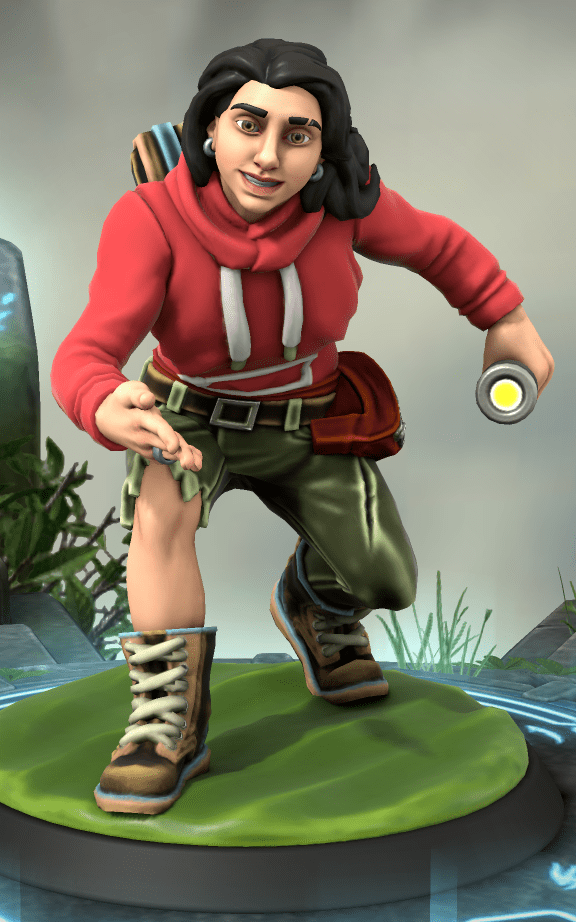
Tara is a businesswoman from Yorkshire, who finds herself on the run in the jungles of Borneo when a bloodthirsty animal spirit takes over one of her fellow volunteers. Tara is tough and resourceful, but even being an HR consultant has never forced her to do things as dark as this.
Maya
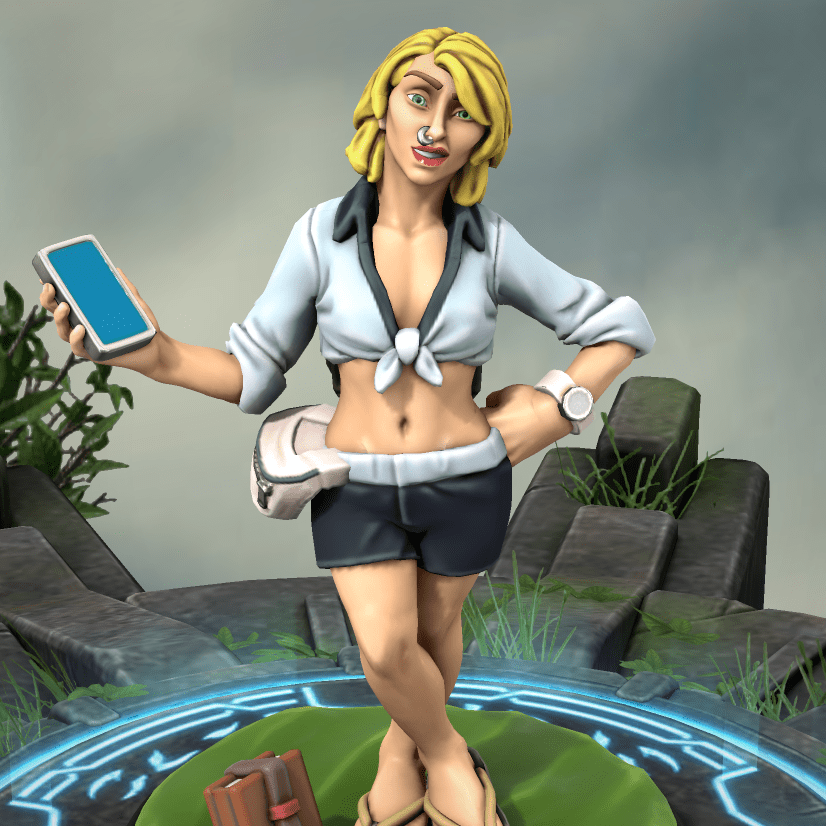
Zoology student Maya thought the rainforest would be three weeks of light work, laughter and wall-to-wall wild orangutans. No-one told her she’d find unexpected love and have to fight for her life. And no mobile signal — WTF is that even about?
Alison

A month of hard work in a tropical rainforest sounded like the perfect place for Alison to recover her sanity and rest her relentless libido, but Cristian’s a constant temptation and Maya’s more competition than she’s used to. At least it’s peaceful out here amongst the trees, right?
Cristian

Cristian really does care about the rainforest, but given the choice between turning his camera on the cute orangutans and Maya’s, um, smile, he knows which one will make this trip a lot more memorable.
Rendy

Rainforest champion Rendy is the manager of Pondok Bahaya research camp, charged with looking after Tara, Maya, Cristian and the rest of the volunteers visiting Borneo this summer. Maybe he should have booked a holiday of his own, instead.
The original version of this post appeared on my 5×5 Medium blog in 2020.
One reply on “Turbocharge your writing inspiration with these character visualisation tools”
[…] can cobble together a decent sketch. I can’t draw to save my life, so I prefer to use tools like HeroForge to create my characters (and if anyone knows a good tool for sketching up spaceship designs and […]